Disclaimer: These are my personal views and do not represent any organization or professional advice.
#farm
Sun, 18 Jan 2026 07:39:54 +0200
Olive Oil: Then and Now
The standard way olives are harvested in Greece by small and big producers alike is typically to get in and get out in as little time as possible using any available means to do so. The biggest producers eliminate the human element entirely by employing large machines which mechanically harvest the olives by putting a vice around each tree and violently shaking it.
Typically, the work begins early morning when cars and pickup trucks are driven into the olive grove and parked inbetween the trees. Vehicles are necessary to bring machinery and power tools, and at the end of the day, haul machinery and the gathered olives away.
A vehicle or petrol generator is then started to power the handheld olive harvesting tools. These agitate the branches causing fruit and leaves to fall from the tree. Plastic tarps or nets are laid out underneath the currently worked on group of trees to catch the olives and leaves as they fall.
Meanwhile, petrol powered chainsaws are used to prune the trees while the harvest takes place. Debate rages at this time as to how much or how little to prune and always falls to the side of extreme or excessive. The prunings with olives on them are immediately passed through a machine which strips them of their fruit and leaves.
Once a group of trees is done, the tarps are folded over and any twigs, sticks or small branches are removed. The olives and leaves are then packed into plastic sacks and set aside to be collected. The tarps are then dragged to the next group of trees and the process continues until the end of the day when the sacks are loaded onto a vehicle and taken home.
If the producer has their own mill or is fortunate enough to have a same day appointment at a public mill, their oil will be pressed within hours of harvest. The majority of small to medium producers however, relying on regional mills, wait their turn in a queue.
So day by day, the sacks accumulate. The olives can be sitting and sweating in plastic sacks for many days until the appointed time where they are taken and pressed into oil. Once the harvest is complete, the prunings are typically piled up and burned on site. The concept of mulching is largely foreign to the Mediterranean.
Public mills are just that, public. To accommodate the large number of people in the queue, the focus is by necessity on passing through as many olives as possible. It is unfeasible for the operator to stop the process and clean the machinery (which can take hours) between customers. Any oil produced therefore is at the mercy of the oil in the queue before it.
As it is uncommon for producers to sell directly to consumers, the bulk of the oil is sold to the mill at the time of pressing, the grower taking home a quantity for friends and family only.
Thus the mill buys up the oil from most of its customers, blending it all together and later selling it to wholesalers. The wholesalers take this oil, blend it together with oil from other mills and again sell it on. This bulk oil is then bought by food companies, cosmetic companies, supermarket chains or even larger wholesalers. The largest wholesalers typically export the oil.
The Consequences
The burning of prunings, chainsaw use, automobiles, generators and petrol powered machines pollute not only the oil but also the soil, trees and olives. The lubricants used in chainsaws create polycyclic aromatic hydrocarbons (PAH) which the EU is trying to better regulate. The plastic tarps and sacks readily shed microplastics which can make their way into both oil and soil.
When handheld olive harvesting tools are used to agitate the tree, the force applied is always the same and when the tool meets resistance it can only power through it. It is impossible for the operator to be gentle and is the reason why small branches, twigs and leaves come down with the fruit.
Using chainsaws to facilitate pruning often results in overpruned trees. The ease with which branches are lopped off compared to a hand saw enables pruning beyond what is necessary for the welfare of the tree.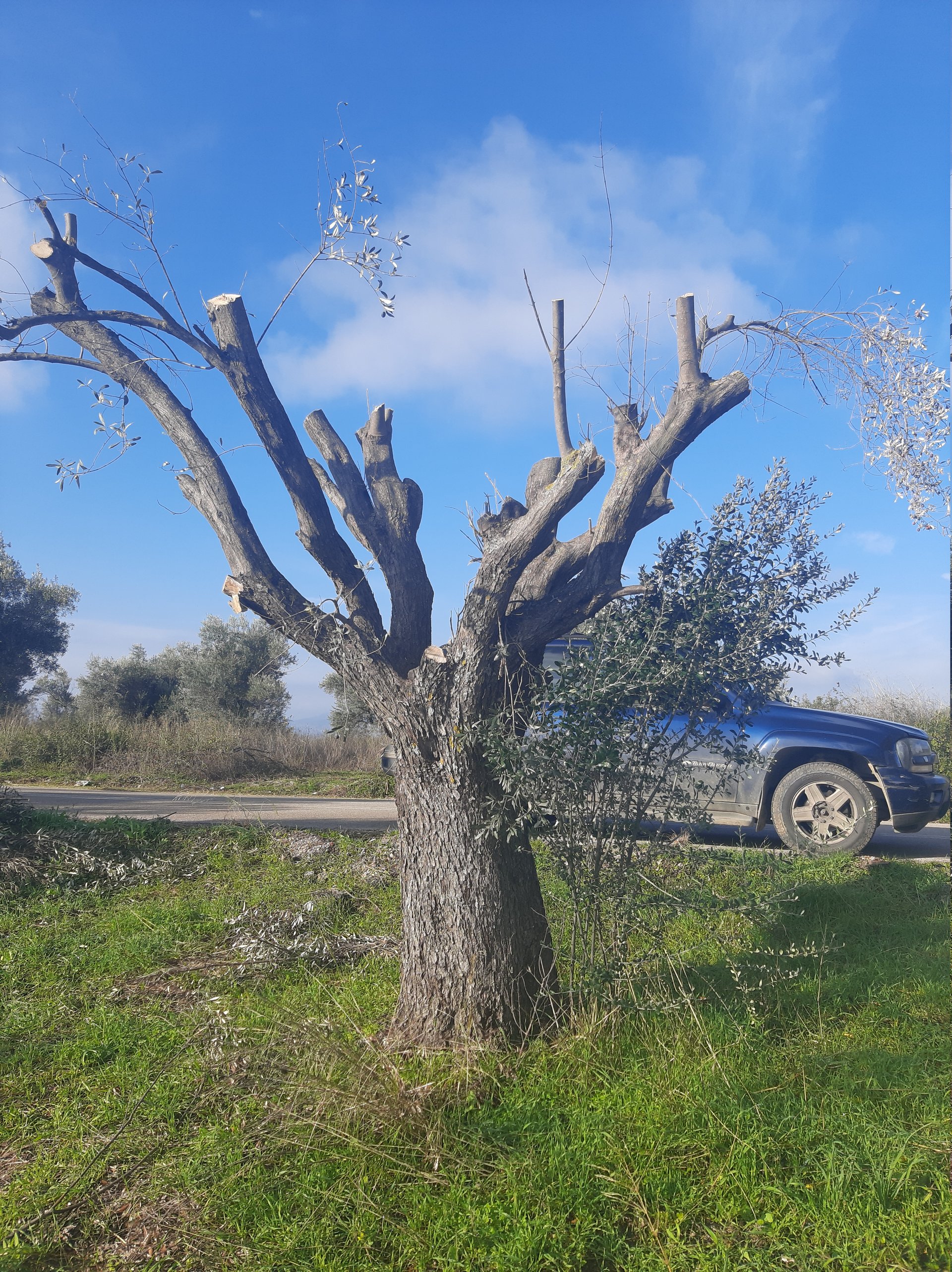
Each cut is a wound. When the cuts get bigger and higher in number, so does the time and energy needed by the tree to close and heal these. Excessive pruning also disrupts the balance between foliage and roots, creating an energy imbalance the tree must correct. If it rains before the tree closes its wounds, healing is slowed and risk of disease increases.
By these practices the lifespan of the tree is reduced and it is unlikely that trees under these conditions will live potential centuries. The effects are visible. Post-harvest, the trees look tired and worn out.
How It Was
It wasn't always like this. Speak to any old timer and with a faraway look in their eyes they will reminisce about other days. Extended families would come together at each other's groves and without the use of plastics, machinery or tools they would hand pick the olives and collect them in cane baskets. Any that were on the ground would be picked up by youngsters. Everyone in the family was involved, it was a labour of love.
At midday, the small swarm of olive gatherers would sit under the shade of the trees and eat from a selection of prepared dishes. There was camaraderie, laughter and much discussion. They were not pressed for time nor was there a push to ramp up production.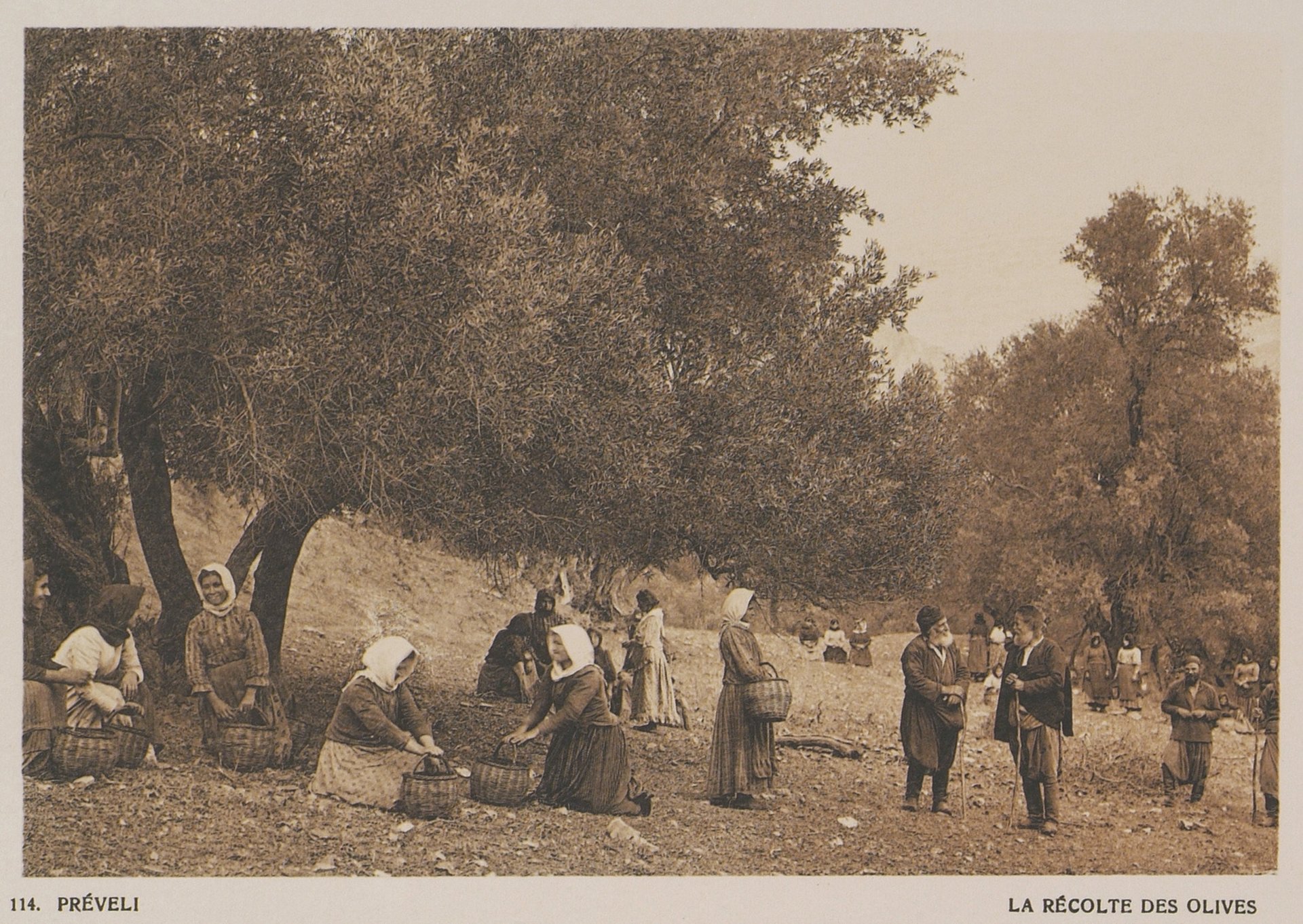
Every village had its own mill and there the olives would be processed family after family everyone helping and everyone taking their share.
The pruning was conducted by handsaw and the trees allowed to grow tall. There are still remnants of these trees towering above the landscape in spots.
The trees gave their gifts and they were accepted whatever the amount. Of course, this was at a time where olive oil was not shipped to the four corners of the earth but rather consumed locally as the staple fat of the region (much like coconut in the Pacific).
Once it became a global commodity and production scaled up, it also became inherently necessary for vehicles, machines, tools and the like to replace manual human labour in order to meet demand. The focus was shifted from personal consumption to profit. At the same time, the shrinking size of families and the loss of the youth to the city and beyond created a vacancy that only migrant labour could fill.
This culminated in what we have today. A hurried get in and get out process where the only thing that matters is yield. The old way can still be found here and there however, but for the most part, it is gone, and with it, it has taken any chance the trees have of a long life.
—Dylan Araps